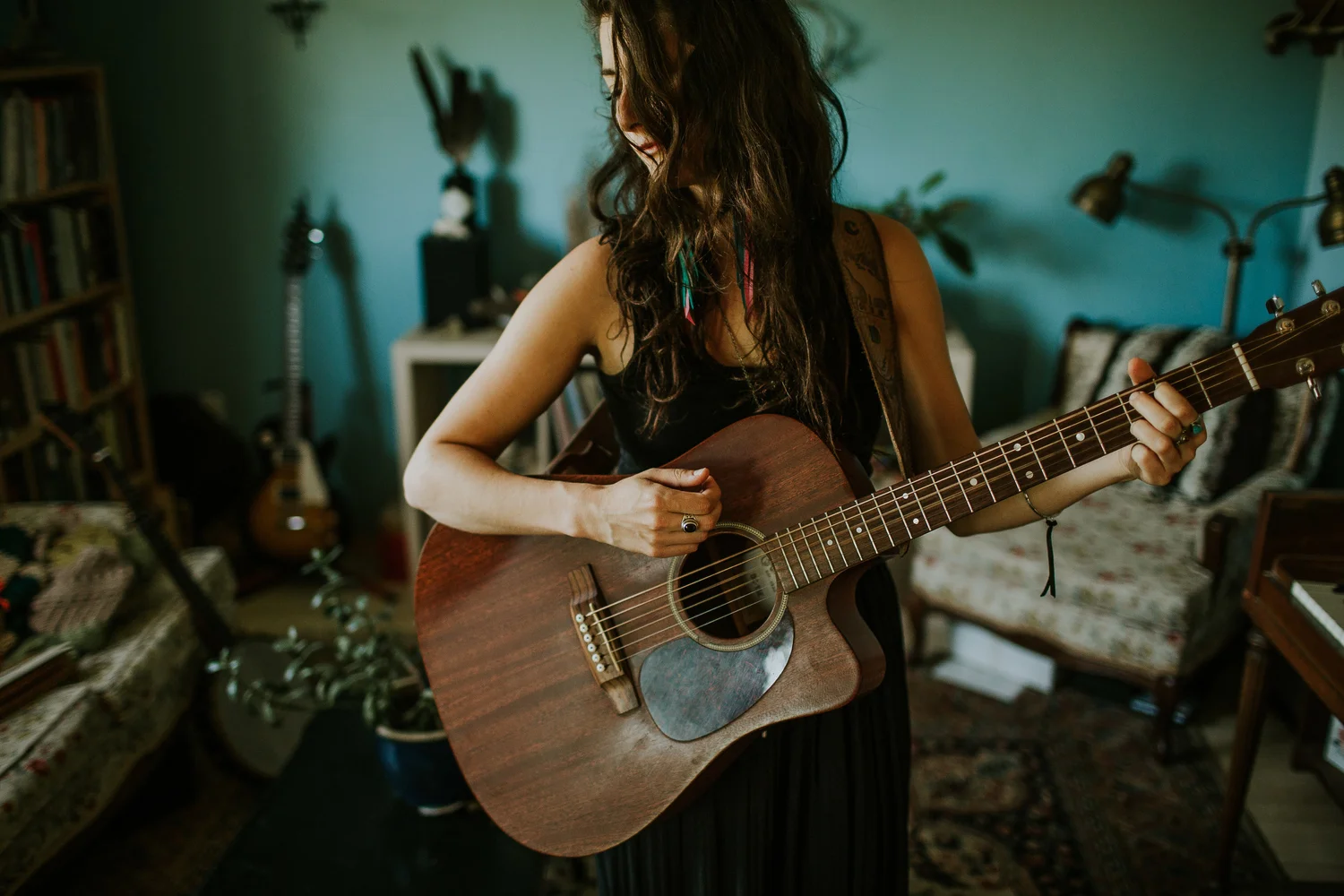
I can't remember learning my first folk song, and I doubt many people can. It's just there — the lullaby a parent hums without thinking, the singalong round a fire where nobody reaches for a phone, some tune an uncle drags out of a battered guitar. That's the odd thing about this music. Nobody sells it to you. It never charts. It just travels, mouth to mouth and hand to hand, until one day it's stitched into how a whole place remembers itself. So let's talk about what folk music actually is, and why it still gets under the skin.
So What Is Folk Music Anyway
Start with the word itself. "Folk" just means ordinary people, and honestly that's most of any folk music definition right there. This is music that belongs to a community instead of an industry. It grows up among regular people, gets handed round by ear, and doesn't really have an author — it belongs to whoever happens to be singing it that night. When someone asks about the folk music meaning, they're usually reaching past the genre label on a streaming app. What counts is how the music gets made and passed on, not only the sound of it.
Which is why it feels nothing like the glossy stuff built to sell. A pop single is chasing whatever's hot this week; a folk song might be lugging two hundred years of small edits behind it. Both belong in an ordinary life — plenty of us drift from a fiddle tune to a favourite playlist to a lazy evening on a site like rollambia casino without any of it feeling at odds. But folk sits on a deeper, older shelf, closer to memory than to fashion.
Where Folk Music Comes From and Why It Sounds Like It Does
This music came out of ordinary days, long before anyone could press a sound onto wax. People sang to get through hard work. They sang at weddings and gravesides, and they sang to hold onto news no paper ever printed. And because it all moved by ear, the songs never sat still for long. A ballad might pick up a verse in one valley and shed one in the next. That drift isn't damage — it's the very thing that gives these old tunes their worn, handled feeling.
The instruments tell the same story of whatever happened to be within reach. Fiddles, banjos, guitars, a cheap tin flute, the voice you were born with. They turn up everywhere for the plainest reasons: light to carry, cheap to own, easy to pass around.
A folk song is never quite finished. Every singer leaves a thumbprint on it, and the tune goes on growing long after the first maker is gone.
So it ends up sounding true rather than polished. The cracked note, the harmony that's a hair off — that's part of the bargain. This was music for real people in real rooms, never a thing to be buffed until it gleamed.
Folk Music Songs and Examples Worth Knowing
The clearest folk music examples tend to hide in plain sight, and a lot of them are more familiar than you'd guess. Odds are you've sung a few without once thinking of the word "folk." The ones below have crossed oceans and centuries, and each points at a different corner of the tradition.
| Song or type | Where it comes from | What it shows |
|---|---|---|
| Scarborough Fair | England | Old ballad reshaped by many singers |
| This Land Is Your Land | United States | Folk as social and political voice |
| Danny Boy | Ireland | Melody that outlived its origins |
| Sea shanties | Coastal work crews | Song built for shared labour |
| Spirituals | African American communities | Music of endurance and hope |
Titles aside, a handful of folk music songs keep surfacing wherever people gather, culture after culture. They usually do a job beyond entertainment, and that's a big part of why they've stuck around.
- Lullabies that settle children to sleep
- Work songs that keep a group in rhythm
- Ballads that tell a long, dramatic story
- Protest songs that carry a shared cause
- Seasonal and holiday tunes tied to the calendar
- Dance tunes played at weddings and gatherings
Every one of those earns its keep on top of simply sounding nice. That working-life root is one reason folk has outlasted flashier things that came and went.
How Folk Music Fits a World of Playlists and Screens
It's easy to picture folk music losing badly to the endless buffet on our screens. The reality is kinder than that. Streaming has quietly handed rare recordings and small regional styles an audience they'd never have found otherwise. A ballad going quiet in one town can land in the ears of someone half a world away who decides to learn it. Here's a rough sketch of how folk and mass entertainment tend to pull in different directions.
| Quality | Folk music | Mass entertainment |
|---|---|---|
| Source | Community and tradition | Studios and platforms |
| Pace of change | Slow, over generations | Fast, driven by trends |
| Who takes part | Anyone who sings along | Mostly an audience |
| What it offers | Belonging and memory | Convenience and novelty |
None of that makes your phone the villain. Screens, playlists, games — they answer real needs, for a rest, for a laugh, for switching off a while.
Folk music isn't asking you to unplug for good. It just wants a little quiet time now and then, the kind where the singing is actually yours.
Balance is really the whole trick. Your phone can hold ten thousand songs, and the tradition still asks for the one thing no device ever hands over: your own voice, thrown in with the rest.
Finding Your Way Into Folk Music
You don't need lessons or a pretty voice to find your way in. It begins with listening a bit harder, then opening your mouth once it feels right. Track down a local session — most of them are glad to see a new face. Dig into the traditional music of wherever your family came from. Sing in the car. Learn three chords and wear them out. Or just ask an older relative what they used to sing, and see where it goes. Folk music was never built to be admired from the cheap seats. It keeps breathing because ordinary people keep taking it up, and there's a spot in it with your name on it.